When I used to think of World War II, my thoughts usually went to my father. He was a WWII veteran and saw a lot of combat bombing Germany and other parts of Europe. I saw WWII from a safe distance, through my dad’s history. He told us simple stories as kids. How he hated Army food and fun he had with his buddies. It was not until I was an adult and delved into his Army history that I learned just how dark that history could be.
While that history was violent and left my dad suffering with PTSD most of his life, I never once thought that anyone else I was related to would have seen the atrocities.
Guess what? I was wrong. Dead wrong. I began thinking about what it would have been like to be living in Poland at the time of WWII and I started looking to see if any of my relatives would have been there to witness the atrocities. I did know that many of my paternal grandfather’s family did not leave Poland or returned back to Poland after a time in the US, but I am still working my way through his history.
I also knew just from researching over the years, that a number of my Plenzler family remained as well in Poland. I had enough names for those who may have been living after 1939 to at least start digging on the Arolson Archives website. I was thinking it would be a long shot to find any of my maternal relatives, but they appeared within moments. My heart hurt to read of their plights.
Thomas Plenzler, son of Jacob and Hedwig Kujawa and was born 9 January 1903 in Wiorek. Thomas was initially arrested by the Gestapo on 16 August 1940. At the time of his arrest, he was 37 year old and has a wife named Therese, living in Boggenburg as a farmer. After Poland was invaded in September 1939, Poznań and the surrounding areas were annexed directly into the German Reich and the Gestapo established a headquarters in Poznań.
The Gestapo targeted Polish civic leaders, clergy, and landowners and classified residents by ethnicity: “Volksdeutsche” (Germans) or “Poles.” Polish farmers were subject to property confiscation, forced labor, or arrest for minor infractions. In 1940, the Gestapo was conducting mass arrests of Poles accused of resistance or “anti‑German sentiment.”
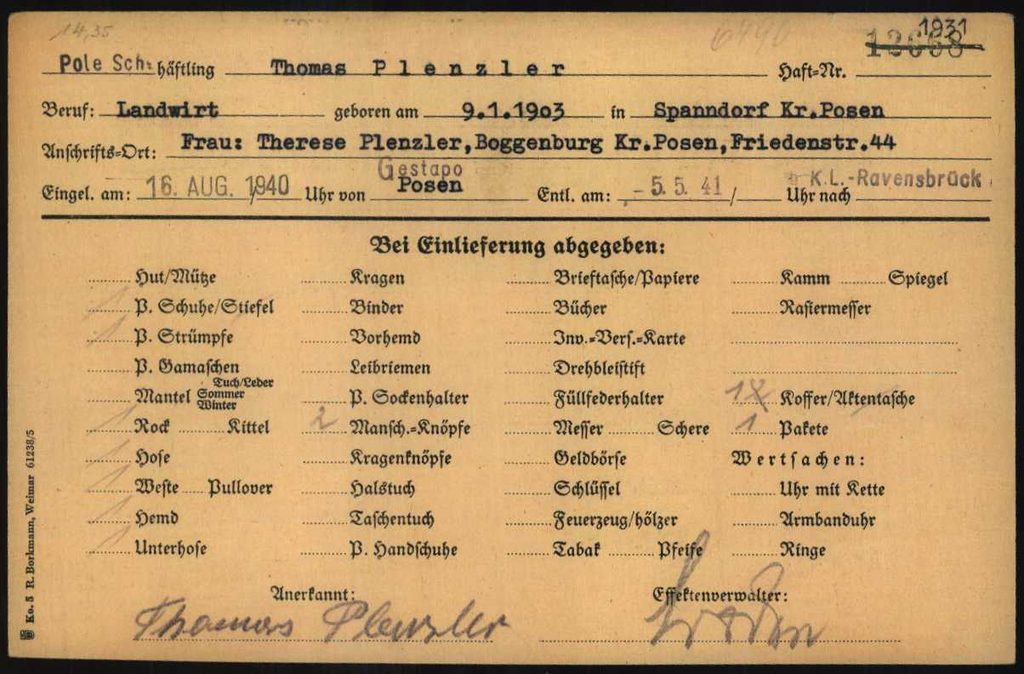
On his arrest record, his occupation is listed as “Landwirt”, a farmer. The Gestapo did a detailed inventory of the possessions he had on him and his signature is on the document stating the inventory is accurate. A partial list of his inventory included
- Hat/cap
- Pair of shoes
- Pair of stockings
- Coat
- Trousers
- Vest
- Shirt
- Underpants
- Collar
- Belt
- Wallet / papers
- Books
- Internal registration card
- Lighter/matches
- Tobacco
- Pipe
- Watch with chain
- Wristwatch
- Rings
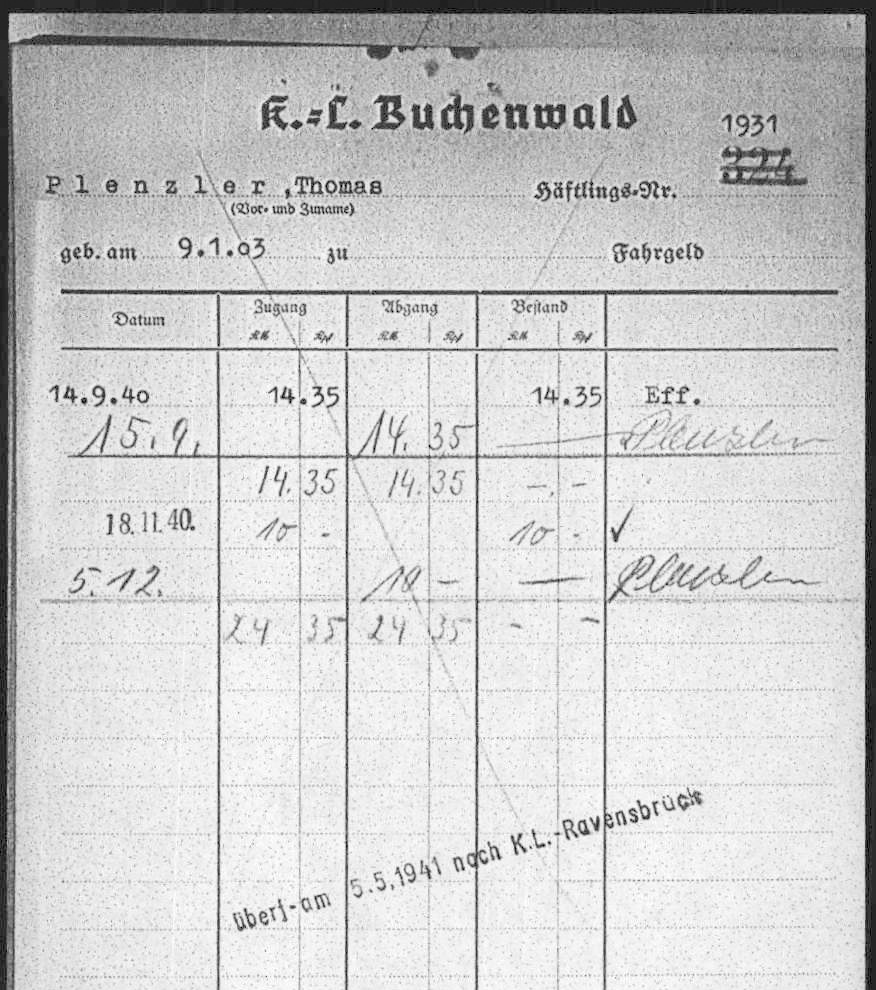
Thomas was initially sent to a local prison in Boggenburg to be held before being sent to Buchenwald on 14 September 1940. He likely was arrested initially a Polish political prisoner and sent to Buchenwald. Buchenwald was initially not an extermination camp but was designed to detain “political agitators” and those who had “anti-German sentiments”. It eventually expanded to include Jews, Poles, Roma, Jehovah Witnesses, homosexuals, and prisoners of war and was a central hub for the SS’s forced labor network, supplying workers to armament factories, quarries, and satellite camps across Germany. Prisoners suffered brutal discipline, starvation, and disease and medical experiments were also carried out at Buchenwald.
At Buchenwald, he was assigned hard labor and on 5 May 1941 was sent to Ravensbrück. Ravensbrück was primarily a women’s camp, but the SS maintained male labor detachments there. Female prisoners were typically sent to work in electrical plants, sewing uniforms, and producing military equipment. Male prisoners were often brought in to perform work typically not relegated to women: building barracks, construction, and heavy industrial type tasks.
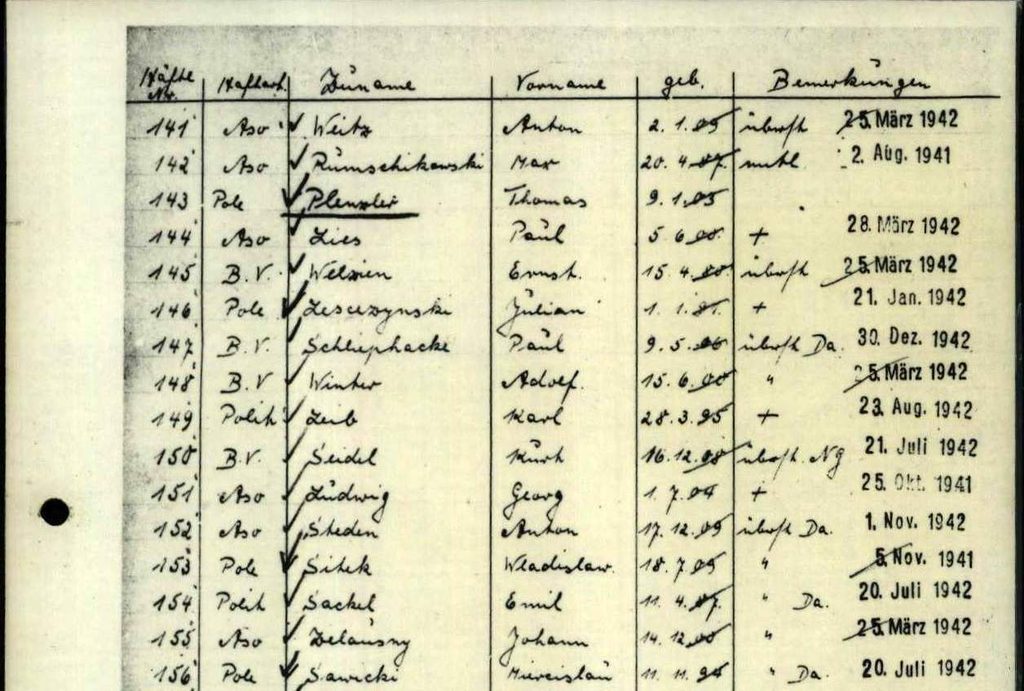
The trail to find Thomas stops in 1941 or 1942. I have been trying to locate deaths in Ravensbrück or possible children he and Therese may have had, but nothing found yet. I’m reasonably sure that he lived through 1941 and possibly 1942. A prisoner list from Ravensbruck dated 1941-1942 does list Thomas, but there is no notation in the final column that notes that he has been moved or died in camp. (Records indicated with a + indicates a death.)
Over 120,00 women and men passed through Ravensbrück, tens of thousands died. Nazis destroyed as many records as possible as the prisons were liberated.
Learning what happened to Thomas brought the atrocities of WWII closer to me. While I see the terror and violence that US military would have experienced in WWII through my father’s eyes, I now have a glimpse of what it may have been like for someone as a victim of the brutalities of the Nazis. Ravensbrück was notorious for a prison block called the bunker, used for torture and solitary confinement of political prisoners. Near the end of the war in 1945, it added a gas chamber and crematorium.
Thomas’ name is listed in the Victims of the Holocaust by the United States Holocaust Museum. His fate at the end of WWII is stated as unknown.